Stanford Stadium (capacity 50,000 as of 2006) is an outdoor athletic stadium on the Stanford University campus, the home of Stanford Cardinal college football team. It originally opened in 1921 as a football and track stadium, an earthen horseshoe with wooden bleacher seating and flooring upon a steel frame. Its original seating capacity was 60,000, which grew to 85,500 by 1927 as a nearly-enclosed bowl. Immediately following the 2005 season, the stadium was demolished and rebuilt as a dual-deck concrete structure, without a track.
Showing posts with label biggest sport stadiums in the world. Show all posts
Tuesday, 13 December 2011
Stanford Stadium
Stanford Stadium (capacity 50,000 as of 2006) is an outdoor athletic stadium on the Stanford University campus, the home of Stanford Cardinal college football team. It originally opened in 1921 as a football and track stadium, an earthen horseshoe with wooden bleacher seating and flooring upon a steel frame. Its original seating capacity was 60,000, which grew to 85,500 by 1927 as a nearly-enclosed bowl. Immediately following the 2005 season, the stadium was demolished and rebuilt as a dual-deck concrete structure, without a track.
Saturday, 10 December 2011
Friday, 9 December 2011
Kaohsiung National Stadium
Kaohsiung National Stadium:
National Stadium is a multi-purpose stadium in Kaohsiung, Taiwan. It is currently the largest stadium in Taiwan in terms of capacity.
Completed in 2009, it will be used mostly for athletics and rugby events, including hosting the main events for the 2009 World Games.
The stadium will have a capacity of 55,000 people. After the games the
stadium will likely be used for some Taiwan football team matches.
The stadium, designed by Japanese architect Toyo Ito, makes use of solar energy to provide its power needs. The World Games Stadium, semi spiral-shaped, like a dragon, will be the
first stadium in the world to provide power using solar energy
technology. The solar panels covering the vast external face of the
stadium are able to generate most of the power required for its own
operation, as well as additional power that can be saved.
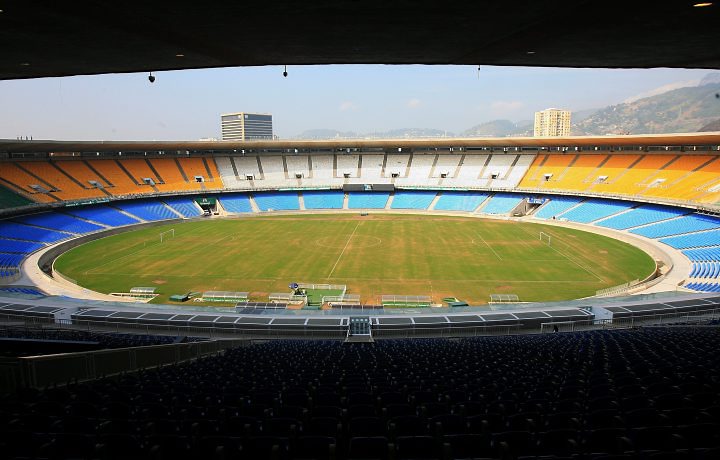
Maracana stadium(part1)
Maracanã (stadium):
The Estádio do Maracanã is an open-air stadium in Rio de Janeiro, Brazil. Owned by the Rio de Janeiro State Government, it is named after the Maracanã neighbourhood in Rio de Janeiro. It was opened in 1950 to host the FIFA World Cup,
and in the final game Brazil was beaten 2-1 by Uruguay. Since then, it
has mainly been used for football matches between the major football
clubs in Rio de Janeiro, including Botafogo, Flamengo, Fluminense, and Vasco da Gama. It has also hosted a number of concerts and other sporting events. Although the paid attendance at the final game of the 1950 FIFA World Cup
was 199,854 (being the world's largest stadium by capacity, when it was
inaugurated), the stadium currently seats 82,238 spectators. It was the main venue of the 2007 Pan American Games, hosting the football final and the opening and closing ceremonies.
Over time, however, the stadium also has become a multi-character
space to receive other events such as shows and games from other sports,
such as volleyball. After several works of modernization, the current
capacity of the stadium is 82,238 spectators, making it the largest
stadium in Brazil and South America.
The Maracanã is currently closed for renovations and upgrades, and
will reach a total capacity of around 85,000 spectators in preparations
for the 2013 FIFA Confederations Cup, the 2014 World Cup, the 2015 Copa America, the 2016 Summer Olympics, and the 2016 Summer Paralympics. The stadium's reopening is forecasted for early 2013.
Thursday, 1 December 2011
Nelson Mandela Bay Stadium(biggest sport stadiums in the world)(part2)
Background:
This is the first time a world-class football stadium has been built in the Eastern Cape province. The city of Port Elizabeth did not have a large scale football facility, as under the apartheid
government, football was not given much funding. Football clubs in the
city had to make use of smaller scale venues throughout the city. Before
this stadium was built, most large football matches were played at the EPRU Stadium,
the city's rugby ground. The EPRU Stadium was often problematic for
football, as it normally hosts rugby matches, thus the playing surface
was not of a great standard. When Port Elizabeth was chosen as a host
city for the 2010 FIFA World Cup,
the city decided against upgrading the EPRU Stadium. This was because
it would have needed to be almost completely rebuilt, in order to be
upgraded to FIFA requirements. The city then decided on building a brand new, multipurpose stadium, in the heart of the city.
Inevitably, there was a great deal of speculation about the status of stadium construction in the run-up to the 2010 FIFA World Cup, with the requirement that all the FIFA World Cup
host stadiums must be completed by January 2010. The Nelson Mandela Bay
Stadium was the first of five new stadiums to start construction. The
other new stadiums are in Cape Town, Durban, Polokwane and Nelspruit.
The stadium is named after the administrative district which the stadium is within, the Nelson Mandela Bay Metropolitan Municipality, itself named after Nelson Mandela, the former President of South Africa. The Nelson Mandela Bay area is made up of the city of Port Elizabeth, the towns of Uitenhage and Despatch, as well as smaller settlements.
The stadium is sometimes incorrectly called the 'Nelson Mandela
Stadium' in the media. This may lead to confusion, as there is a Nelson Mandela Stadium in Kampala, Uganda.
It is also sometimes mistakenly claimed that the stadium is named after
Mandela, rather than the metropolitan area named in his honour.
Nelson Mandela Bay Stadium(biggest sport stadiums in the world)(part1)
Nelson Mandela Bay Stadium:
Nelson Mandela Bay Stadium is a 48,000-seater stadium in Port Elizabeth.
The five-tier, R2
billion (approximately $159 million) Nelson Mandela Bay Stadium was
built overlooking the North End Lake, at the heart of the city. It is
one of three coastal stadiums built in anticipation of the 2010 FIFA World Cup. It regularly hosts large scale football (soccer) and rugby union matches. The stadium has also been used as a concert venue.
Subscribe to:
Posts (Atom)